Tofu Drifter
- 3.8
- Rating
- 1.00M
- Installs
- Free
- Price

 Analysis by App-foxy
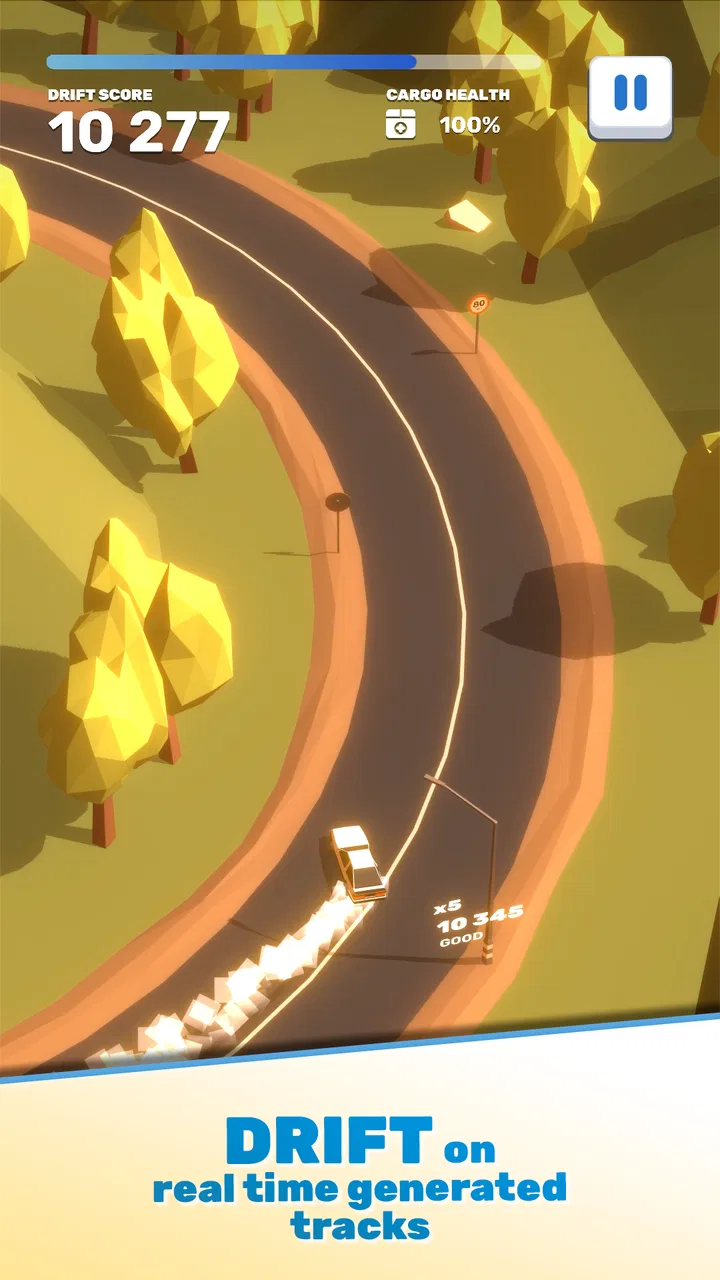
I spent time with Tofu Drifter, a free racing game from Egor Nemov built around one focused idea: controlling a car through drifts rather than simply chasing top speed. That narrow focus gives it a clear identity. It is not trying to be a full driving simulator or a large collection of licensed vehicles. Instead, it asks whether you can keep a slide alive, correct your direction, and turn a corner without losing control.
That makes it an appealing choice for short sessions. I could pick it up when I had only a few minutes, concentrate on one difficult turn, and stop without feeling that I had abandoned a long campaign. At the same time, the simple premise can become demanding once the early novelty fades. The game’s enjoyment depends heavily on whether you like repeating a maneuver until your hands understand it.
Learning the slide instead of chasing speed
The first thing I noticed is how different drifting feels from ordinary mobile racing. In a conventional racer, I usually think about braking points, acceleration, and taking the cleanest line. Here, the slide itself becomes the main task. I am constantly balancing entry speed, steering, and recovery. A corner is not finished when the car points toward the exit; it is finished when I have kept enough control to leave it cleanly.
You May Also Like

 Blood Strike: 2.5 Anniversary
Blood Strike’s Loadouts Turn Every Drop Into a Tactical Gamble
A close look at Blood Strike’s custom loadouts: how fast access to signature weapons reshapes its battle royale rhythm, rewards preparation, and narrows the gap between fights.

 Pandora - Music & Podcasts
Pandora’s Music Is Easy to Start, but Harder to Recover
Pandora’s strength is its low-effort path from a seed to a station. Its weak spot is how much confidence it asks you to place in connection, setup, and quiet recovery.

 8 Ball Pool
 Is Built on Rivalries, Rematches, and Routine
A close look at the rivalries, rematches, shared routines, and unanswered safety questions that turn a quick pool match into a persistent mobile community.

 Samsung Music
’s Quiet Strength Is Playing What You Already Own
Its reach comes less from spectacle than from dependable access to a personal library. That simplicity is both the app’s strongest retention engine and its ceiling.

 AccuWeather: Weather Radar
AccuWeather Review: A Quick, Clear Forecast for Everyday Decisions
For everyday plans, the best forecast is the one you can understand quickly. AccuWeather makes rain timing, radar, and local conditions easy to act on, with a few trade-offs.

 Hill Climb Racing
Why Hill Climb Racing Still Turns Crashes Into One More Run
A tiny car, a bumpy hill and one more upgrade: Hill Climb Racing keeps resurfacing because its simple chaos makes every near-miss feel personal.
More From Our News Desk
View All News


That creates a useful rhythm. I approach a turn, commit to the drift, make small corrections, and then decide whether to hold the angle or straighten out. The best moments come from a correction that feels almost too late but saves the run. The weakest moments come when a tiny mistake ruins an otherwise promising attempt, especially if I was trying to extend a slide instead of taking the safer line.
The game’s store summary, “Master the art of drifting!”, is a fair description of its central appeal, but it does not explain the patience involved. This is not a racing game I would recommend to someone who wants instant victories or realistic road behavior. It suits players who enjoy learning a compact control system and gradually making their movements less wasteful.
I also found that short practice sessions work better than forcing a long play period. After several attempts, I began reacting too quickly and overcorrecting. Taking a break helped more than stubbornly repeating the same mistake. That is a small but important tip: treat each run as a lesson in timing, not just as another chance to win.
Why the compact format works on a phone
Tofu Drifter belongs to the racing category, but it feels more like a focused skill game than a broad motorsport package. There is value in that restraint. I do not need to learn a large roster of cars, memorize complicated menus, or spend time setting up a detailed career before driving. The game gets to its main interaction quickly.
That makes it suitable for a commute, a waiting room, or a short break between tasks. In an everyday situation, I could play a few attempts while waiting for an appointment, put the phone away, and return later without needing to remember a complicated story. The same quality can feel limiting if I want variety, exploration, or a sense of a large racing world.
Compared with arcade racers that emphasize traffic, boosts, spectacular jumps, or constant unlocks, this game places more weight on control. Compared with serious driving simulators, it is easier to approach and less concerned with reproducing every part of car handling. I would choose it when I want to practice a specific feeling rather than imitate a complete racing discipline.
Progress can become a test of patience
The satisfying part of progression is personal improvement. A corner that felt impossible begins to look readable, and a run that once ended in a spin can become controlled. That kind of progress does not always need a large reward system because I can feel the difference in my own inputs. For me, the strongest motivation was returning to a section and discovering that I no longer had to think about every correction.
The trade-off is that repetition can create pressure. If the game expects a precise sequence, experimentation may feel expensive in time even when it costs nothing financially. I sometimes wanted to try a reckless line simply to see what would happen, but the desire to preserve a good attempt encouraged safer choices. Players who enjoy perfecting a route will probably appreciate that tension; players who prefer constant novelty may find it narrow.
A practical approach is to separate learning from scoring. On the first attempts, I focus on where the car begins to rotate and how much steering is needed to recover. Only after that feels familiar do I worry about extending the drift or improving the result. This prevents the common mistake of chasing a better outcome before understanding why the previous run failed.
What spending means here
The game is free to download, with optional in-app purchases listed at between $2.99 and $6.99 per item. That gives the basic entry point a low barrier, while still making spending part of the overall decision. I would install it first and decide later rather than paying before I knew whether the drifting felt comfortable on my device.
Those purchase amounts are clear, but the practical value of each item is not something I would assume without seeing it in context. I would want to know whether a purchase changes convenience, appearance, progression speed, or access to content before spending. Since those distinctions affect fairness, I would treat the paid options as optional until I understood exactly what they do.
That uncertainty matters more in a skill-focused racer. If money can bypass difficult practice, some players may feel that improvement is being replaced by purchasing. If purchases are mainly cosmetic or supportive, the competitive concern is smaller. I would not promise either interpretation without direct confirmation inside the game, so my advice is simple: play enough of the free version to judge whether the core loop stands on its own, then inspect each item carefully before buying.
For a child’s device, the Everyone content rating is reassuring in terms of the stated age category, but I would still use the device’s purchase controls. The age label and the payment question are separate issues. A game can be suitable for a broad audience while optional purchases still deserve adult oversight.
Is the competition fair?
Tofu Drifter’s fairness depends less on the familiar racing question of who has the fastest car and more on how much the game lets skill matter. The most satisfying runs I experienced came from better timing and steadier corrections, not from simply pressing harder or moving faster. That is a good foundation for fair play because the central challenge is visible in the player’s hands.
Still, a fair-feeling system needs clear boundaries. If a paid item provides a meaningful driving advantage, then the game would move away from a pure practice contest. If it does not, the free starting point has a stronger case. I would avoid judging the purchase system by the existence of prices alone. The important question is what those purchases change during play.
This is also where the game differs from online racing alternatives. In a multiplayer racer, fairness involves matchmaking, connection quality, vehicle balance, and the behavior of other drivers. Here, my main opponent is my own previous attempt. That removes some common competitive problems, but it also means the game may feel less exciting to someone who needs direct rivalry. I would choose this experience for self-improvement rather than social competition.
Another useful distinction is between difficulty and unfairness. A demanding turn is not automatically unfair if the result follows from a repeatable input. I became frustrated when I reacted emotionally and turned too much, but that was different from the game changing the rules without warning. Players who are sensitive to retry-heavy design should give the free version a fair trial before deciding whether its pressure feels motivating or exhausting.
Questions I would ask before installing
One practical question is whether an older phone can run it. The minimum requirement is Android 8.0, so anyone using an Android device below that version should not expect compatibility. For supported devices, I would still begin with a short test session because control games are especially sensitive to touch response, screen size, and how comfortable the steering input feels in the hand.
Another question is whether the game is suitable for a quick session or demands a long commitment. In my experience, its drift-centered design works well in brief bursts. I can practice one idea without needing to complete a large event. That said, meaningful improvement takes repetition, so a player who dislikes returning to the same challenge may not get much from the format.
Some readers will also wonder whether it replaces a full racing game. I would say no. It is better viewed as a specialized drifting experience. If you want broad vehicle selection, varied race types, a story, or a deep simulation model, a larger racing title will probably be a better match. If you want a small game built around keeping a slide under control, this one has a clearer purpose than many general racers.
It is also worth asking whether the free version is enough to judge the game. I believe it is the right starting point, especially because the main appeal is the handling itself. If the controls do not feel natural in the opening sessions, a purchase is unlikely to fix that fundamental mismatch. If the core driving clicks, then the optional items can be considered separately rather than treated as an entry requirement.
What I would like to know before spending
The purchase range is visible, but the reason to buy each item should be evaluated in the game rather than guessed from the price. I would check whether the item affects progression, changes the car’s behavior, unlocks a visual option, or simply adds convenience. That check is especially important for a game whose main satisfaction comes from mastering control.
I would also pay attention to whether a paid advantage changes the way I approach difficult corners. A helpful item that removes the need to learn the drift could weaken the very part I enjoy. On the other hand, a purely optional addition may be reasonable for a player who wants to support the developer, Egor Nemov, after deciding that the free experience is worthwhile.
My spending rule would therefore be conservative: do not buy during the first burst of excitement, and do not buy because a difficult section feels frustrating. First determine whether the frustration is the productive kind that leads to improvement. If it is, keep practicing. If it is not, spending may only make the disappointment more expensive.
How it compares with familiar racing choices
Large arcade racers usually win on spectacle. They may offer a stronger sense of speed, more varied environments, and a wider stream of rewards. Their weakness is that the central driving skill can become diluted by boosts, collisions, upgrades, and busy presentation. Tofu Drifter is more focused. Its identity comes from the drift rather than from everything surrounding it.
Simulation-oriented games win on realism and depth. They are better for players who want detailed vehicle behavior, careful braking, and a broader understanding of racing lines. This game is less demanding in that direction, but it is also less intimidating. I can concentrate on the feel of a slide without first learning a complete set of racing procedures.
Endless driving games are often better for relaxation because they allow a loose, continuous flow. Tofu Drifter asks for more deliberate attention. The short attempt structure and repeated corrections make it a better fit for active practice than for passive entertainment. I would not choose it when I want to switch off completely; I would choose it when I want a small mechanical challenge.
That comparison also explains who should skip it. If your ideal mobile racer is about collecting vehicles, competing against live opponents, or exploring an extensive world, this focused drifting format may feel too limited. If you enjoy precision, retries, and the quiet satisfaction of making one turn cleaner than before, its narrow scope becomes an advantage.
My experience with the game’s pressure
The pressure in a drift game comes from commitment. Once the car starts sliding, I have fewer safe options than I would in a normal turn. I must decide whether to hold the angle, reduce it, or accept a less stylish exit. That decision-making is what gives the game its character, but it can also make small errors feel larger than they would in a casual racer.
I found it helpful to use conservative entries while learning. Entering a corner too aggressively may look impressive, but it gives less time to understand the correction. A slower, controlled approach teaches more because I can see which input caused the car to rotate. Once that movement becomes familiar, I can gradually take more risk without confusing speed with skill.
A second useful habit is to judge the whole exit, not only the start of the slide. A drift that begins beautifully but leaves the car badly positioned is not necessarily a successful maneuver. Thinking about where I want to be after the corner made my attempts more consistent. This is the kind of insight that does not appear in a short store description, but it changes how the game feels after the first few sessions.
I would also avoid playing with a nearly empty battery or while multitasking. Precision games punish interruptions more than menu-driven apps do. A notification, awkward grip, or rushed thumb movement can turn a manageable corner into a failed attempt. The game is simple enough for casual use, but its best moments deserve a little attention.
Trust, expectations, and the final decision
The game has been available since September 28, 2020, and its current version is 1.4.10. It has passed one million installs, with an average rating of 3.8 from around 8.6 thousand ratings and 257 reviews. Those figures suggest a real audience, but they do not replace personal testing. A drift-focused game can appeal strongly to one player and feel repetitive to another even when both are looking at the same listing.
I appreciate that the basic download is free because the handling is the part I need to evaluate first. The optional purchase range is reasonable to examine carefully, but I would not treat any item as necessary until its effect is clear. That is my main trust condition: the free experience should communicate the game’s value, and paid options should be understandable before money changes hands.
My final recommendation is fairly specific. Install it if you want a compact racing game centered on drifting, enjoy improving through repetition, and prefer competing against your own control rather than against a crowded online field. Start with patient entries, learn the recovery movement, and judge the game after several short sessions rather than one rushed attempt.
Skip it if you need constant variety, realistic motorsport depth, or a social racing scene. The focused design is its strength and its limitation. For me, Tofu Drifter works best as a small skill challenge: free to try, easy to understand, and most rewarding when I stop chasing dramatic slides and start treating every corner as a lesson in control.
FAQs for Tofu Drifter
01What is Tofu Drifter, and how do you play it?
Tofu Drifter is a casual driving game centered on drifting, timing, and maintaining control through winding tracks. After trying it, the main appeal is its simple pick-up-and-play design: you steer, slide around corners, collect rewards, and aim for better scores. The controls are easy to understand, although mastering smooth drifts takes practice, especially on tighter courses and faster sections.
02Is Tofu Drifter suitable for beginners and younger players?
Yes, Tofu Drifter is generally approachable for beginners because its core mechanics are straightforward and the early stages give you time to learn the steering and drifting system. It has a lighthearted visual style rather than a realistic racing presentation. However, later challenges can require concentration and quick reactions, so younger players may need some practice before completing the more demanding tracks.
03Can Tofu Drifter be played offline?
Tofu Drifter may offer playable racing or drifting content without a constant internet connection, which is convenient for short sessions while traveling. However, certain features can depend on connectivity, including advertisements, online services, updates, leaderboards, or purchases. Availability may also differ between Android and iOS versions. It is best to launch the game once while connected and check which features remain accessible offline.
04Does Tofu Drifter contain ads or in-app purchases?
The game may include advertising and optional in-app purchases, depending on the platform, region, and current version. Ads can commonly appear between attempts or during reward-related interactions, while purchases may provide cosmetic items, currency, upgrades, or other conveniences. Before downloading, review the store listing and your device’s purchase settings, particularly if children will be playing on the same account.
05What devices are compatible with Tofu Drifter, and is it worth downloading?
Compatibility depends on the release version and the operating system requirements listed on Google Play or the App Store. Tofu Drifter should run best on a reasonably recent device with enough free storage and updated system software. It is worth downloading if you enjoy short arcade sessions, drifting challenges, and score improvement. Players seeking a deep simulation or extensive multiplayer experience may find it less suitable.
Pros
- Relaxed drifting gameplay that is easy to learn
- Short races fit well into quick gaming sessions
- Cute tofu-themed visuals give the game a unique identity
- Simple controls work comfortably on mobile screens
- Unlockable content adds motivation to keep playing
Cons
- Gameplay may feel repetitive after extended sessions
- Progress can become slower as challenges get harder
- Limited customization may disappoint racing fans
- Some stages require precise timing to master
- Ads or in-app purchases may interrupt the experience

Tofu Drifter
Gallery